

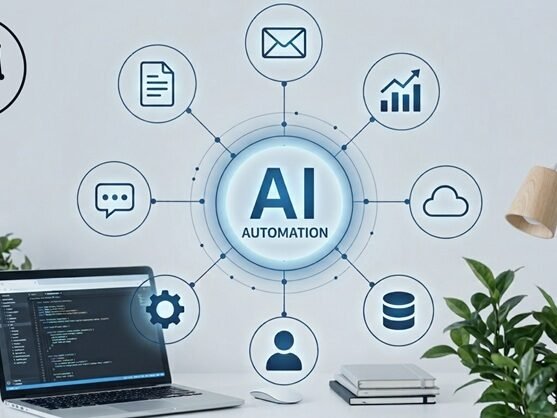
AI agents for business automation are changing how work gets done shifting it from rigid, rule-based execution to flexible, judgment-driven task completion. For decades, automation meant writing a fixed set of instructions for software to follow exactly, which worked well for predictable processes but broke down the moment a situation fell outside the rules it was given. AI agents remove that limitation. Because they can reason about a task rather than just follow a script, they can handle the natural variation present in real business processes opening up automation to a much wider range of work than was previously possible, especially for small and mid-sized businesses that could never justify the cost of custom rule-based systems in the first place.
If you're still deciding whether "agent" is the right word for what you need, our breakdown of AI agents vs. chatbots is a useful place to start before reading further.
The Old Model of Automation
To understand why this shift matters, it helps to look at what automation looked like before AI agents entered the picture. Traditional automation, often built through rule-based software or basic workflow tools, relies on explicit conditional logic: if a certain field contains a certain value, trigger a certain action. This approach works well for highly structured, unchanging processes, like moving a file from one folder to another or sending a confirmation email after a form submission.
The problem is that most real business processes are not that clean. A customer support inquiry might be phrased a dozen different ways. An invoice might arrive in a slightly different format than expected. A lead might not fit neatly into a predefined category. Traditional automation handles these edge cases poorly, usually by failing silently or routing everything unusual back to a human — which quickly erodes the time savings the automation was supposed to provide in the first place.
What Changed With AI Agents
AI agents solve this problem by replacing fixed rules with reasoning. Instead of matching a rigid condition, an agent interprets the actual content and context of a situation and decides what to do, the same way a trained employee would handle a task that technically follows a process but still requires judgment along the way. This is the foundation of agentic AI development, and it is the reason AI agents can be deployed on far messier, more human-facing workflows than older automation tools ever could. For a deeper look at how this reasoning loop actually works, see our explainer on what an AI agent is and how it works.
This shift is not just theoretical it shows up directly in how much of a process can actually run without human intervention. A rule-based system might successfully automate twenty percent of incoming customer requests, with the rest requiring manual handling because they do not match a predefined pattern. An agent-based system, because it can reason through variation instead of failing on it, can often handle a much larger share of that same volume, only escalating to a human when a situation genuinely requires it. This tracks with what the broader market is reporting: McKinsey's most recent global survey found that regular AI use across at least one business function has climbed to 88 percent of organizations, even as most are still working out how to scale beyond pilots.
Where This Shift Is Showing Up Most
Certain areas of business operations have seen the clearest impact from this change:
- Customer support — AI agents now handle inquiries end to end, checking order or account information, resolving straightforward issues directly, and escalating only the cases that actually need a person.
- Lead management — agents can qualify incoming leads, respond with relevant information, schedule follow-ups, and update a CRM automatically instead of requiring a sales team to manually triage every new contact.
- Document and data processing — where older automation tools required documents to follow an exact, predictable format to be processed correctly, AI agents can interpret varied formats, extract the relevant information, and route it appropriately. This matters enormously for businesses dealing with invoices, contracts, or forms that rarely look identical twice.
- Scheduling and operations coordination — agents manage appointment bookings, confirm availability, and handle rescheduling without staff needing to touch a calendar for routine cases.
Why This Matters More for Smaller Businesses
Larger companies have historically had the resources to build custom rule-based automation for their specific processes, even if it took significant time and expense to maintain. Small and mid-sized businesses generally have not had that option, which meant a lot of repetitive operational work simply stayed manual because building traditional automation for it was not cost-effective at that scale.
AI agents change that calculation. Because a well-built agent can reason through variation rather than needing every scenario explicitly programmed in advance, the cost and time required to automate a given process has dropped considerably. This is a major reason demand for AI agent development services has grown fastest among small and mid-sized businesses not because larger enterprises aren't interested, but because smaller businesses are finally getting access to a level of automation that was previously out of reach for their size and budget. Enterprise-wide adoption is still catching up to the hype, too: Forbes reported on McKinsey research showing that only around 23 percent of organizations are actively scaling an agentic AI system in even one business function, with another 39 percent still experimenting — which means most of the market, regardless of company size, is still early.
A Real-World Example of AI Agents for Business Automation
Consider a small property management company handling maintenance requests from tenants. Under a traditional automation approach, the system might only successfully process requests submitted through a specific form with specific dropdown options, since anything written in free text was too unpredictable to parse reliably. Everything else went to a staff member to read and route manually.
An AI agent handling the same workflow can read a maintenance request written in plain language, understand the nature of the issue even when described inconsistently, determine its urgency, check which vendor or technician handles that type of issue, and schedule the appointment directly, following up with the tenant to confirm. The business did not need tenants to change how they communicate. The system adapted to the way people actually write, which is precisely the kind of flexibility that separates modern AI agents for business automation from what came before it.
The Shift From Task Automation to Process Ownership
Perhaps the most significant change AI agents have brought to business automation is a shift in scope. Older automation tools typically handled a single step within a larger process, like sending an automated email, while a person still managed everything around it. AI agents are increasingly capable of owning an entire process from start to finish, including the judgment calls in between.
This is the real difference behind AI workflow automation as it exists today compared to a few years ago. It is not just that individual tasks got faster entire multi-step processes, previously requiring constant human coordination, can now run largely on their own, with people stepping in only for genuine exceptions or decisions that carry real consequence.
What This Means for Businesses Evaluating Automation Today
For a business assessing where to apply this technology, the key takeaway is that the old assumption that only simple, highly predictable tasks are worth automating no longer holds. Processes that were previously considered too variable or too judgment-dependent to automate are now realistic candidates, provided they are scoped and built correctly by a capable AI automation agency or AI agent development company.
This does not mean every process should be handed to an agent immediately. It means the boundary of what is automatable has moved substantially, and businesses that reassess their operations with that shift in mind tend to find far more opportunity than they expected. A process someone dismissed as too inconsistent to automate two years ago may well be a strong candidate for custom AI agent development today.
Looking Ahead
The pace of change here is unlikely to slow down. As the underlying models continue to improve, the range of tasks agents can reliably handle without human oversight will keep expanding, and the cost of building and deploying them will likely continue to drop. For small and mid-sized businesses, this represents a genuine opportunity to close the operational gap that has traditionally favored larger competitors with bigger teams and bigger automation budgets.
The practical next step for most businesses is identifying which specific processes in their own operations are the strongest candidates for this kind of automation, and understanding what a realistic AI agent development services engagement actually involves in terms of scope, timeline, and cost. You can see examples of processes we've automated for clients in our work, or get in touch to walk through what a scoped engagement would look like for your business.