
An AI agent is a software system that perceives information, makes decisions, and takes action on its own to complete a task. It does this without a human directing every step. Unlike a traditional chatbot that answers a question and waits for the next prompt, an AI agent plans a sequence of actions, uses external tools, remembers context from earlier in a task, and adjusts its approach when something doesn't go as expected. For small and mid-sized businesses in the US, this distinction matters, because it separates a novelty chat window from a system that can run parts of a workflow unattended.
Why This Question Matters Right Now
Search interest in terms like custom AI agents and AI agent development services has grown sharply over the past year. Business owners no longer ask whether AI can help them. They ask how to apply an AI agent to something concrete, like responding to leads, processing invoices, or managing support tickets. Understanding what an AI agent is, and how it differs from older automation tools, is the first step toward a smart investment decision. According to McKinsey's research on AI adoption, businesses that clearly define their automation goals before implementation see significantly better outcomes than those who adopt AI tools reactively. This is also the foundational question any AI automation agency should answer clearly before proposing a solution, because a mismatched expectation here is the single biggest reason automation projects fail to deliver.
Breaking Down the AI Agent Definition
At its core, an AI agent runs on a loop. It observes the current state of a task, reasons about the next step, takes an action, then evaluates the result before deciding what to do next. This loop lets an agent handle multi-step work instead of a single isolated request. A traditional automation script follows a fixed path instead. If a step fails or an unexpected input appears, the script breaks or stalls. An AI agent, especially one built on a modern large language model, recognizes when something unexpected happens. It can adjust, ask for clarification, or try a different approach.
This is the essential difference between simple automation and agentic AI development. Automation executes predefined rules. An AI agent makes judgment calls within a defined scope, using reasoning instead of rigid conditional logic. That reasoning capability makes custom AI agent development valuable for businesses whose workflows involve variability, like handling different customer inquiries, extracting information from inconsistent document formats, or qualifying leads based on nuanced criteria.
The Core Components of an AI Agent
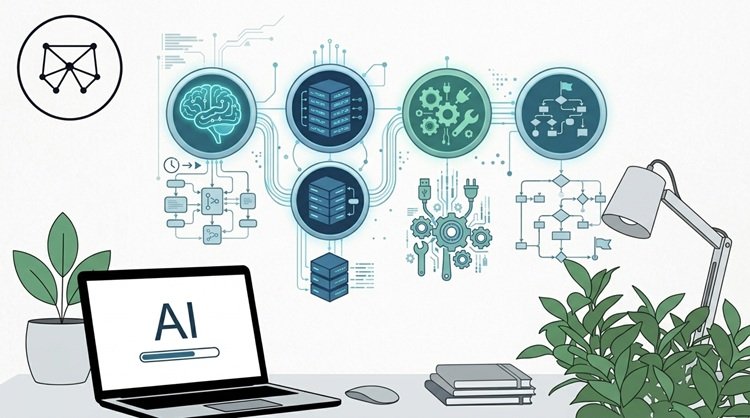
Every AI agent includes a few essential building blocks. The reasoning engine, almost always a large language model, interprets instructions and decides what to do. Memory lets the agent retain context across a conversation or a multi-step process, instead of treating every interaction as brand new. Tools and integrations give the agent the ability to act in the real world, such as sending an email, updating a CRM record, querying a database, or calling an external API. A planning layer breaks a broad goal into smaller steps and sequences them logically.
When these pieces work together, the result is a system that can take an instruction like "follow up with every lead that hasn't responded in five days" and carry it out from start to finish. It checks the CRM, drafts a personalized message, sends it, and logs the outcome. No person has to manually complete each part. This is the practical promise behind business AI automation. It doesn't replace judgment entirely; it removes the repetitive execution work that judgment doesn't actually require.
How an AI Agent Differs From a Chatbot
Many business owners still associate AI with chatbots. That's an understandable assumption, given how visible customer-facing chat widgets have become. But a chatbot is generally reactive. It waits for a message, generates a response, and stops. It doesn't take independent action, retain long-term memory of prior sessions, or chain together multiple steps toward a goal, unless it's specifically engineered to do so.
An AI agent is proactive within its defined scope. An event can trigger it, like a new form submission or an incoming email, and it works through a sequence of decisions and actions on its own. This is why companies offering AI agent development services usually build agents for specific operational tasks, such as appointment scheduling, order processing, inventory monitoring, or first-line support triage. They rarely position an AI agent as a general-purpose chat assistant. The value comes from narrowing the scope enough that the agent can act reliably within it.
A Practical Example of an AI Agent at Work
Consider a small logistics company that receives shipment status inquiries by email throughout the day. Handling these manually means someone reads each email, looks up the shipment in a tracking system, and writes a reply. An AI agent built for this task monitors the inbox, extracts the shipment reference number from each message, queries the tracking system directly, and composes a reply with the current status. It flags anything unusual, like a significantly delayed shipment, for a human to review instead of answering automatically. This is a clear illustration of custom AI automation in action. It's not a chatbot bolted onto a website; it's a working process that removes a specific, repetitive burden from a team's day.
This use case also shows the difference between a generic AI tool and a properly scoped custom AI agent. An off-the-shelf assistant might draft an email if given all the details manually. An agent designed for this workflow gathers the details itself, decides what to do with them, and only involves a person when the situation genuinely calls for judgment.
Why Businesses Are Moving Toward Agentic Systems
The shift toward agentic AI development comes down to a simple economic reality. Labor for repetitive administrative and operational tasks is expensive and hard to scale quickly. This hits small and mid-sized businesses hardest, since they can't always justify hiring a full-time employee for a task that only takes a few hours a week but still needs to happen every day. An AI agent handles that class of work at a fraction of the cost, without the ramp-up time tied to hiring and training.
Reliability matters too. Humans handling repetitive tasks are prone to fatigue-driven errors, especially with tasks like data entry or status updates. These don't require much thought, but they do require consistency. A well-built AI agent performs the same task the same way every time. That consistency matters in areas like invoice processing, compliance checks, or scheduling, where a small mistake can create outsized downstream problems.
What This Means for Choosing a Development Partner
The term AI agent gets used loosely across the industry, so it's worth being specific when evaluating an AI agent development company. A genuine AI agent makes decisions; it doesn't just execute a fixed script with an AI-generated message layered on top. Ask a potential partner to walk through exactly how their agent handles unexpected input, what happens when it isn't confident about a decision, and how it hands off to a human when necessary. These questions quickly reveal whether you're looking at real agentic capability or a rebranded automation tool.
Ask how the agent gets trained or configured for your specific business context too. A generic agent with no understanding of your products, policies, or tone produces generic, sometimes incorrect, output. A properly built custom AI agent is built around your actual data, your actual workflows, and the specific edge cases your business runs into. That's a meaningfully different undertaking than deploying an out-of-the-box tool.
Getting Started With Your First AI Agent
For most small and mid-sized businesses, the right starting point isn't a sweeping AI transformation across every department. Identify one clearly defined, repetitive, rules-based process that currently consumes real staff time, and build or deploy an AI agent specifically for that. Success there builds the internal confidence and operational understanding needed to expand into AI workflow automation across other parts of the business.
Understanding what an AI agent is and how it works is the necessary first step before that conversation can happen productively. From here, explore what a realistic AI agent development services engagement looks like in terms of timeline and cost, and take a look at real AI agents we've built for other businesses to see what this looks like in practice.